- English
- Español
- Português
- русский
- Français
- 日本語
- Deutsch
- tiếng Việt
- Italiano
- Nederlands
- ภาษาไทย
- Polski
- 한국어
- Svenska
- magyar
- Malay
- বাংলা ভাষার
- Dansk
- Suomi
- हिन्दी
- Pilipino
- Türkçe
- Gaeilge
- العربية
- Indonesia
- Norsk
- تمل
- český
- ελληνικά
- український
- Javanese
- فارسی
- தமிழ்
- తెలుగు
- नेपाली
- Burmese
- български
- ລາວ
- Latine
- Қазақша
- Euskal
- Azərbaycan
- Slovenský jazyk
- Македонски
- Lietuvos
- Eesti Keel
- Română
- Slovenski
- मराठी
- Srpski језик
Rockchip Microelectronics Empowers AI TVs
RK1828 Empowers a Company's RGB-Mini LED Era Flagship Product
The new viewing experience for the 2026 FIFA World Cup in North America, Canada and Mexico is hidden within the AI computing power of a company's RGB-Mini LED era flagship TV!
As the official sponsor of this World Cup, a certain enterprise's RGB-Mini LED TV UX is equipped with the Rockchip RK1828 general-purpose edge-side AI coprocessor. It uses the local large model capabilities to reshape the interactive experience for large-screen viewing, bringing professional AI computing power into the living room.
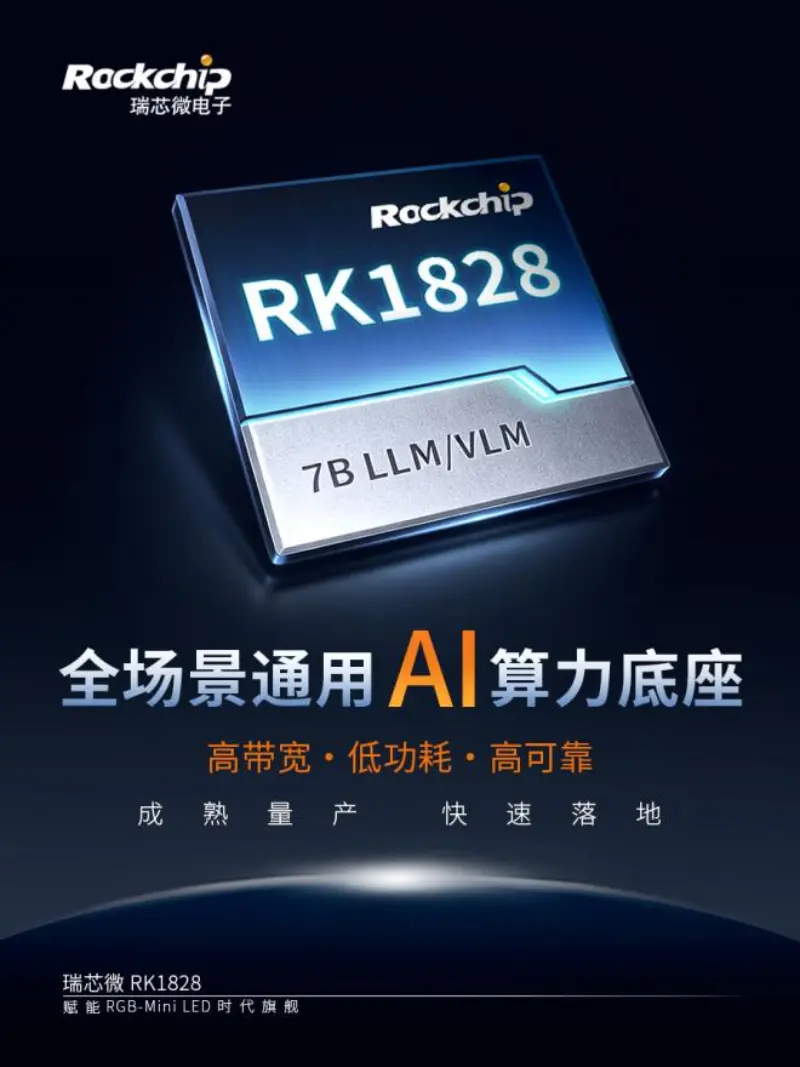
As a general-purpose AI computing infrastructure for the edge side developed by Rockchip, RK1828 adopts an independent coprocessor architecture, breaking through the core bottlenecks of traditional terminals in terms of computing power, bandwidth, and latency, and injecting native edge-side AI capabilities into smart TVs:
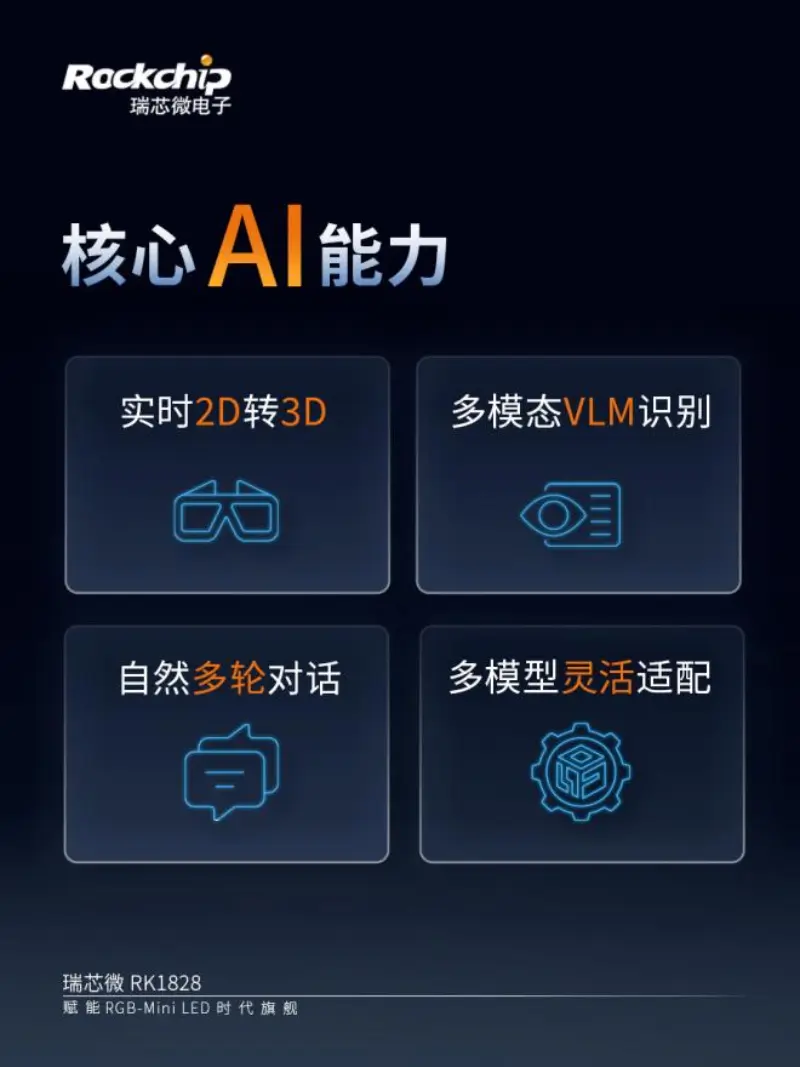
Intelligent upgrade of event video display | Real-time 2D to 3D conversion for live broadcasts of ordinary sports events. Real-time 3D rendering of the stadium provides a stronger sense of depth, enhancing the on-site experience of watching the game and ensuring low latency and no ghosting throughout the process.
VLM multi-modal video recognition enables understanding of every detail on the field, automatically identifying players, teams, and event data. With a single click, player profiles, game scores, and historical match information can be popped up. Watching the game no longer requires frequent device switching to look up information.
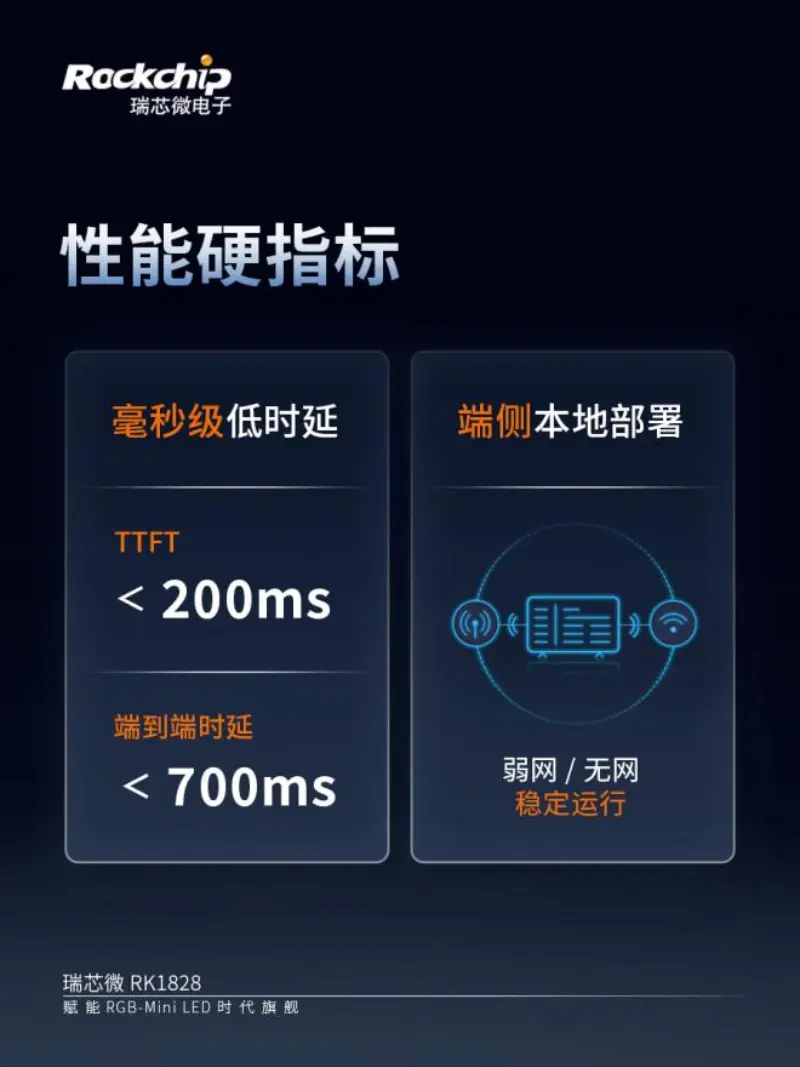
Offline smooth multi-round voice conversations, smooth interaction during watching the game. TTFT latency is less than 200ms. Continuous voice question responses are smooth. Local AI functions are fully available even in weak network or disconnected network conditions. Watching the game no longer relies on stable broadband.
Flexible large model adaptation, suitable for both event and daily scenarios. Native support for mainstream 7B large models such as Gemma4. Combined with multiple LoRA and KV Cache configurations, the functions of watching the game, family audio and video, and life assistant can be freely switched.
Industry value
By adopting a decoupled computing power design, it does not occupy the resources of the main chip. It can provide native AI computing power for new models and also enable rapid AI upgrades for existing terminals, significantly reducing the development and upgrade costs for manufacturers.
Currently, RK1828 has been successfully deployed in various types of terminals such as high-end smart TVs. It is not limited to event viewing; it can also be applied in multiple terminal scenarios such as digital humans, intelligent cabins, and desktop robots, providing a new path for lightweight edge-side large model deployment for hardware manufacturers. All industry manufacturers are welcome to negotiate cooperation and jointly create more competitive intelligent hardware products!