- English
- Español
- Português
- русский
- Français
- 日本語
- Deutsch
- tiếng Việt
- Italiano
- Nederlands
- ภาษาไทย
- Polski
- 한국어
- Svenska
- magyar
- Malay
- বাংলা ভাষার
- Dansk
- Suomi
- हिन्दी
- Pilipino
- Türkçe
- Gaeilge
- العربية
- Indonesia
- Norsk
- تمل
- český
- ελληνικά
- український
- Javanese
- فارسی
- தமிழ்
- తెలుగు
- नेपाली
- Burmese
- български
- ລາວ
- Latine
- Қазақша
- Euskal
- Azərbaycan
- Slovenský jazyk
- Македонски
- Lietuvos
- Eesti Keel
- Română
- Slovenski
- मराठी
- Srpski језик
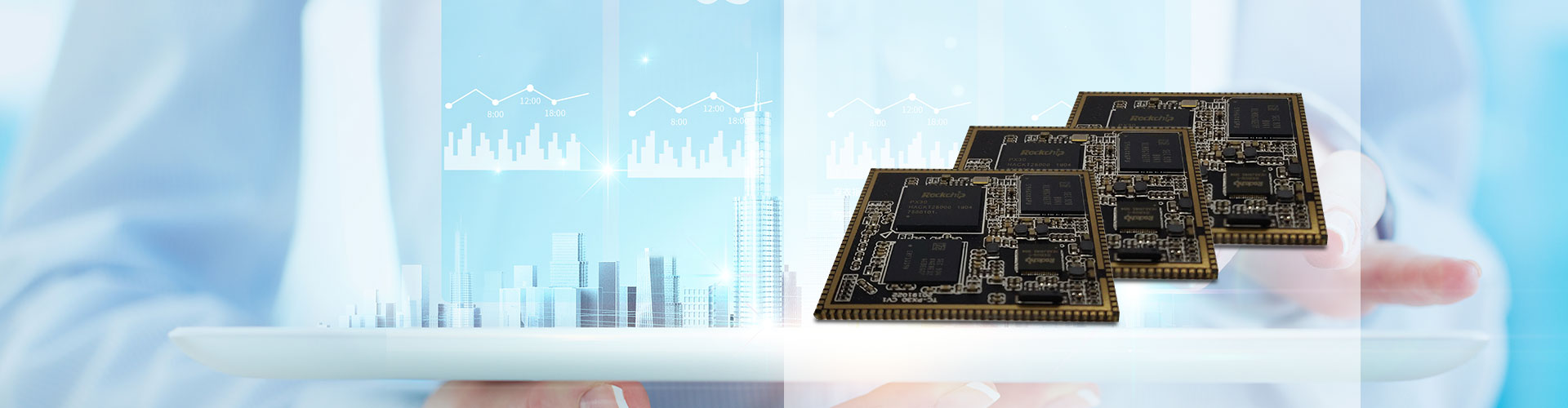
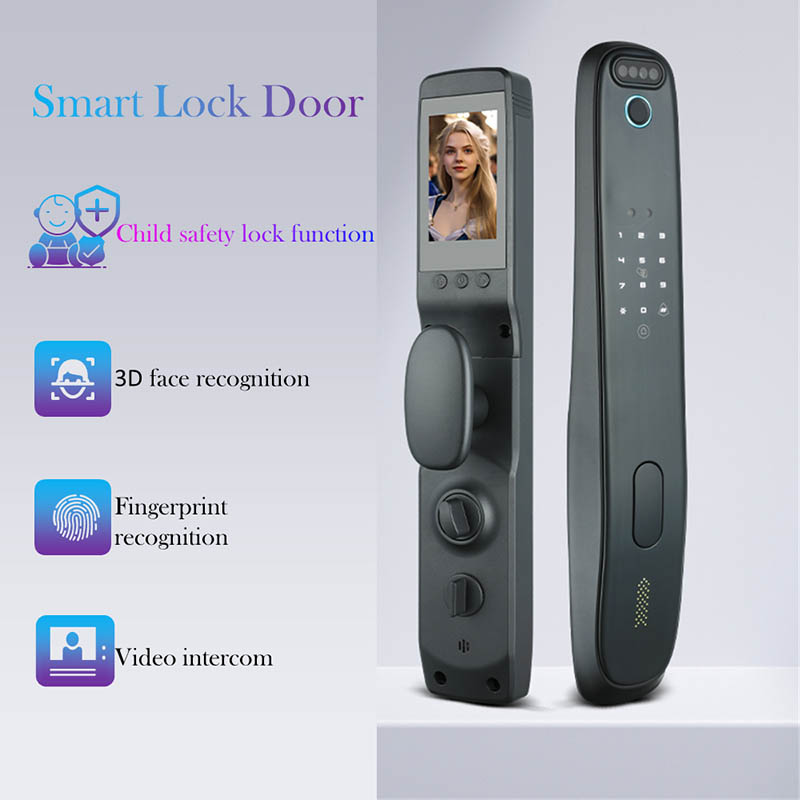
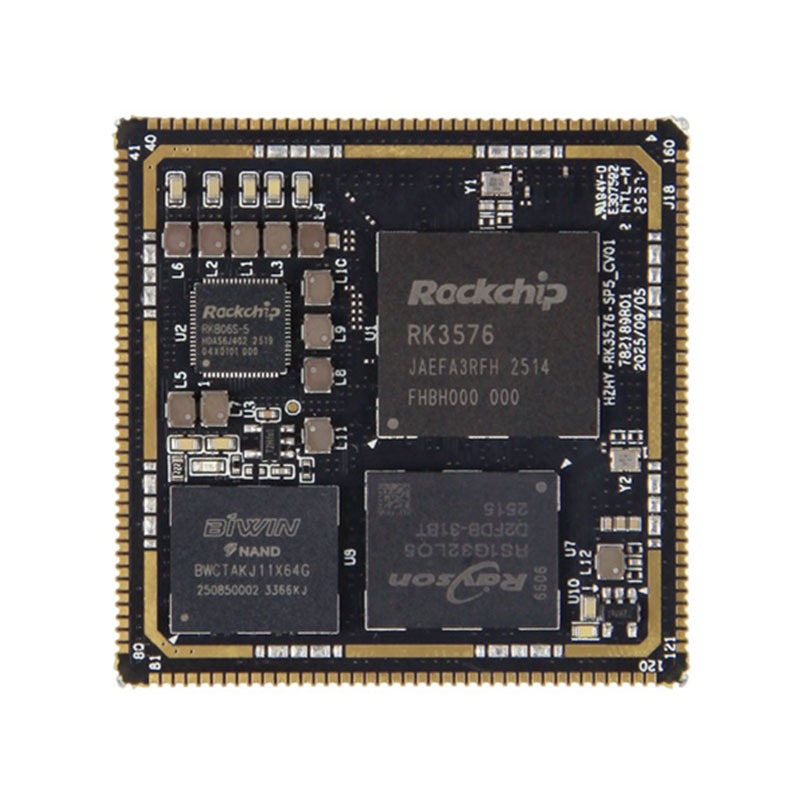
Rockchip RK3576 SOM
The Rockchip RK3576 System on Module (SOM) is a high-performance, industrial-grade embedded solution designed to empower a wide range of intelligent edge devices. Built on Rockchip's advanced processor technology, this compact and integrated SOM delivers exceptional computing power, robust AI inference capabilities, and reliable multimedia performance, making it an ideal choice for industrial automation, AIoT, and embedded intelligent systems.
Send Inquiry
Product Description
At the core of the RK3576 SOM lies a powerful octa-core CPU configuration, featuring four Cortex‑A72 cores running at 2.2GHz and four Cortex‑A53 cores at 1.8GHz. This big.LITTLE heterogeneous architecture enables intelligent load balancing, ensuring superior performance for complex multi-tasking while optimizing power efficiency for extended operation—critical for industrial environments with strict energy requirements.
Equipped with a 6TOPS@INT8 NPU, the RK3576 SOM excels in on-device AI inference. It supports mixed-precision operations including INT4, INT8, and FP16, and is fully compatible with mainstream deep learning frameworks such as TensorFlow and PyTorch. This allows developers to seamlessly deploy AI applications like computer vision, speech recognition, and edge analytics without relying on cloud computing, reducing latency and enhancing data privacy.
The integrated Mali‑G52 MC3 GPU further enhances the SOM's multimedia and graphics capabilities. Supporting industry standards like OpenGL ES 3.2 and Vulkan 1.2, it enables smooth 3D rendering, high-definition video processing, and advanced UI visualization—perfect for applications such as industrial HMI, digital signage, and intelligent surveillance systems.
As an industrial-grade solution, the RK3576 SOM is engineered to meet the rigorous demands of industrial environments, ensuring stable operation even in harsh conditions. We offer flexible OEM and ODM customization services tailored to your specific project requirements, including custom interface configurations, memory options, and software optimization. Whether you need a standard RK3576 core board or a fully customized embedded board, our solution accelerates your product development cycle and reduces time-to-market.
Choose the Rockchip RK3576 SOM for a reliable, high-performance embedded platform that combines industrial-grade durability, powerful AI computing, and versatile customization—unlocking new possibilities for your intelligent edge applications.
RK3576 SOM Hardware Specifications
● CPU: Quad-core Cortex-A72 processor + Quad-core Cortex-A53 processor
● Clock Speed: 2.2GHz
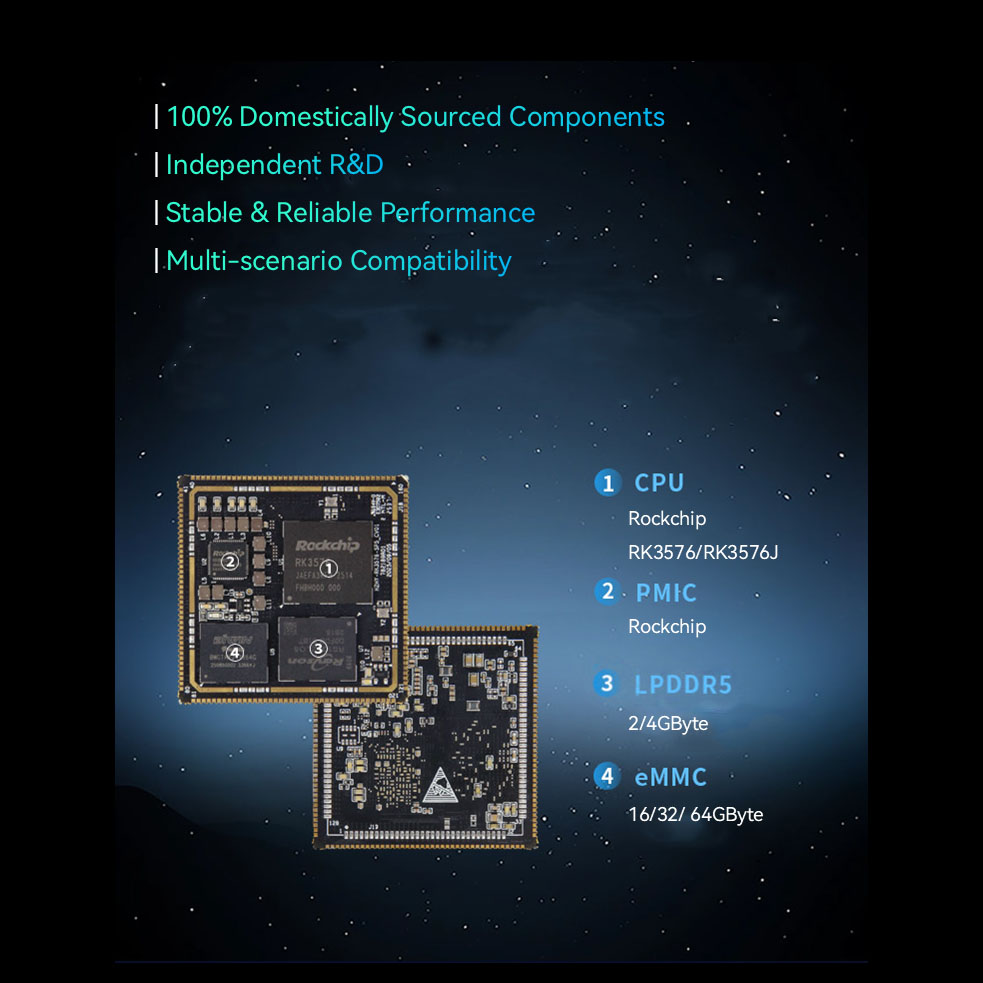
● Memory: 2/4GB LPDDR5 (Capacity varies depending on the purchased version)
● EMMC: 32/64GB eMMC (Capacity varies depending on the purchased version)
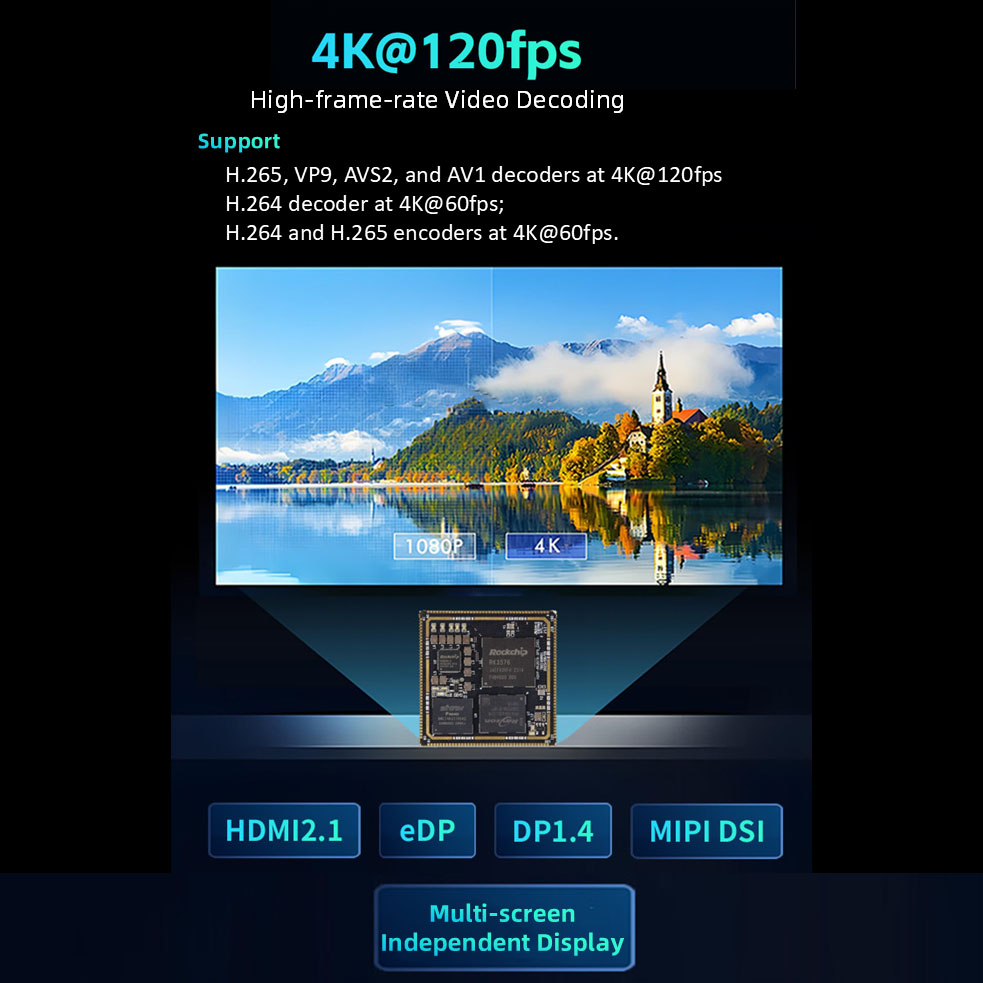
● Multimedia Processing: Supports 4K@120fps H.265, VP9, AVS2, and AV1 decoders; supports 4K@60fps H.264 decoder; supports 4K@60fps H.264 and H.265 encoders, high-quality JPEG encoder/decoder
● Graphics Processor: ARM Mali-G52-MC3
● NPU: Built-in independent NPU, 6 TOPS computing power @INT8
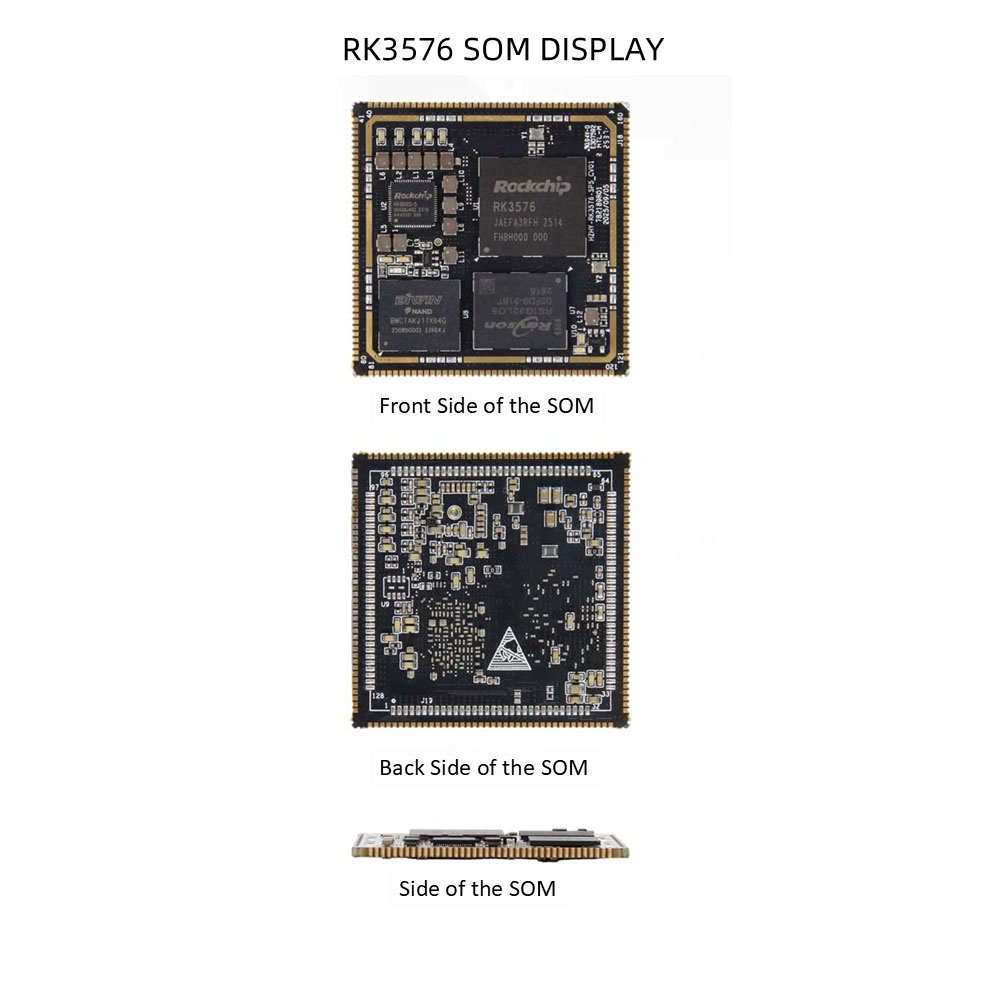
● Dimensions: 45mm x 45mm
● Interface: Stamp-hole interface, 288 pins
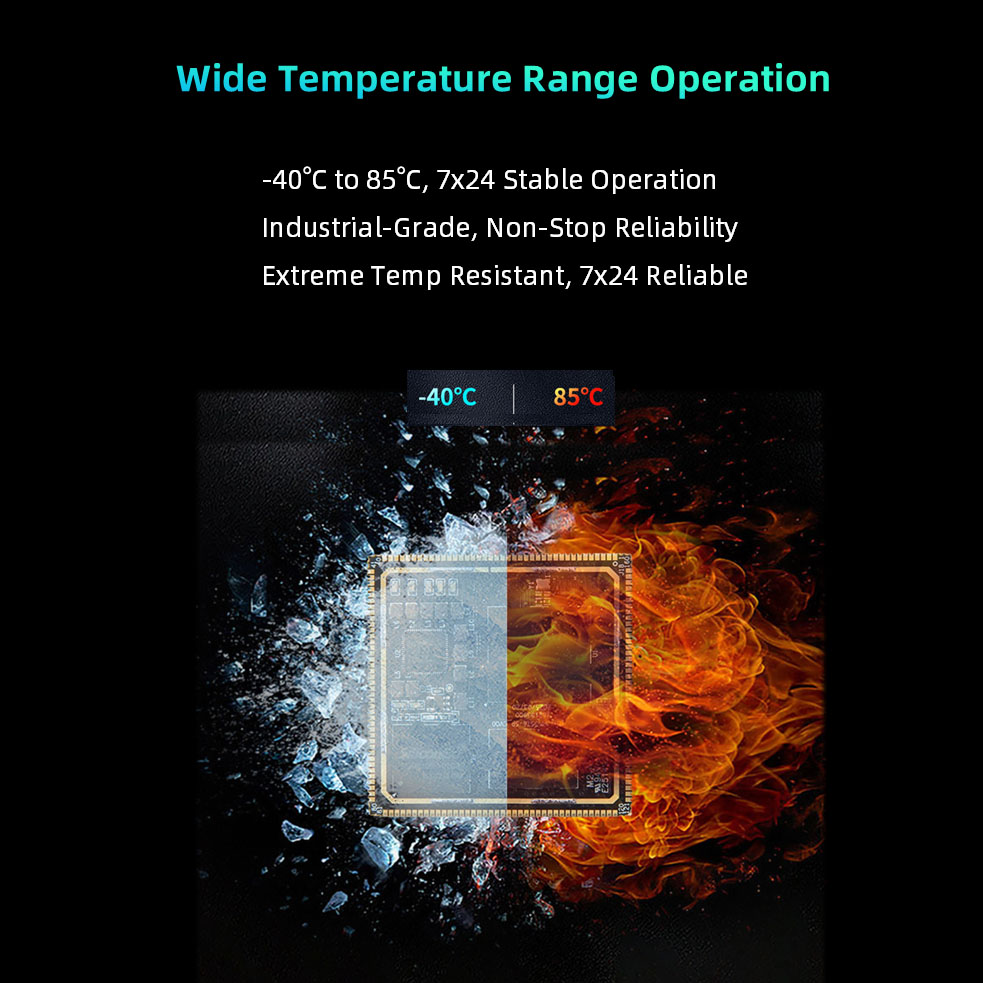
● Temperature: -40°C~+85°C / 0°C~+70°C
● Operating Voltage: 5V
● Operating System: Linux, Ubuntu
RK3576 SOM Functional Parameters
● SDMMC (≤2 channels): Supports SDI03.0 protocol and MMCV4.51 protocol. 4-wire data bus width; supports SDR104 mode, with a maximum speed of 200MHz. Note: Only SDMMC0 supports System Boot, and is defaulted to the SD card function;
supports firmware upgrade via SD card when EMMC/UFS is blank, and also supports firmware upgrade of EMMC/UFS via SD card after EMMC/UFS boot; SDMMC0 configures VCCIO_SD_S0 to 1.8V or 3.3V output according to the peripheral and actual operating mode; SDMMC1 is 3.3V; some pin resources are multiplexed.
● SARADC (≤7 channels): SARADC resolution is 12-bit, speed 1MS/s, input voltage range is 0~1.8V; Note: SARADC_VINO_BOOT is dedicated to setting the SYSTEMBOOT boot sequence and cannot be used for other functions; SARADC_VIN1 is defaulted as the key value input sampling port, and is multiplexed as the Recovery mode button (not modifiable);
SARADC_VIN2 is the board hardware ID, not brought out; SARADC_VIN3 is multiplexed for audio detection;
SARADC_VIN4~7 can be used directly.
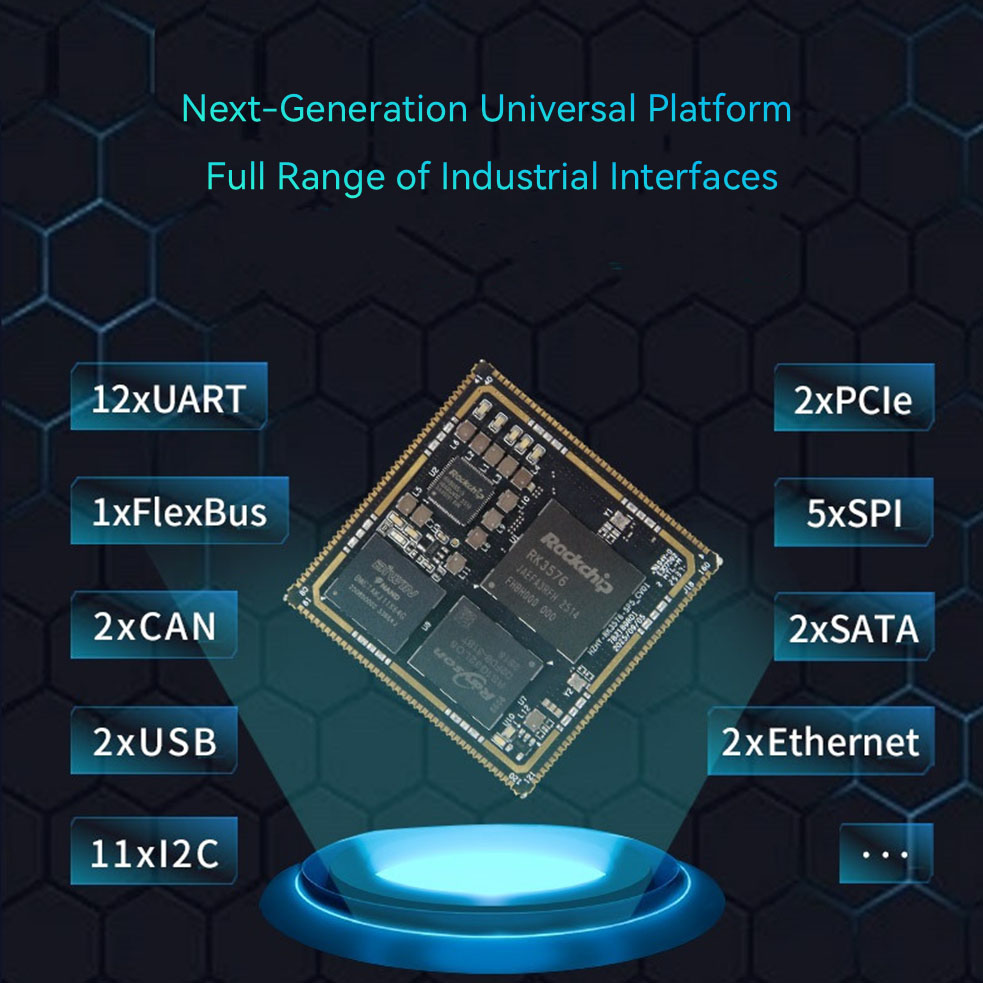
● USB (≤2 channels): Note: USB2_OTG0 is the default firmware burning port for RK3576, please be sure to reserve this interface in the application; USB3 and USB2.0 OTG can only function as Device or HOST simultaneously; the SS signal (5Gbps) of USB3 OTG0 is multiplexed with DP1.4; the SS signal (5Gbps) of USB3 OTG1 is multiplexed with PCIE1 or SATA1, and the USB function cannot be used when set to PCIE or SATA function;
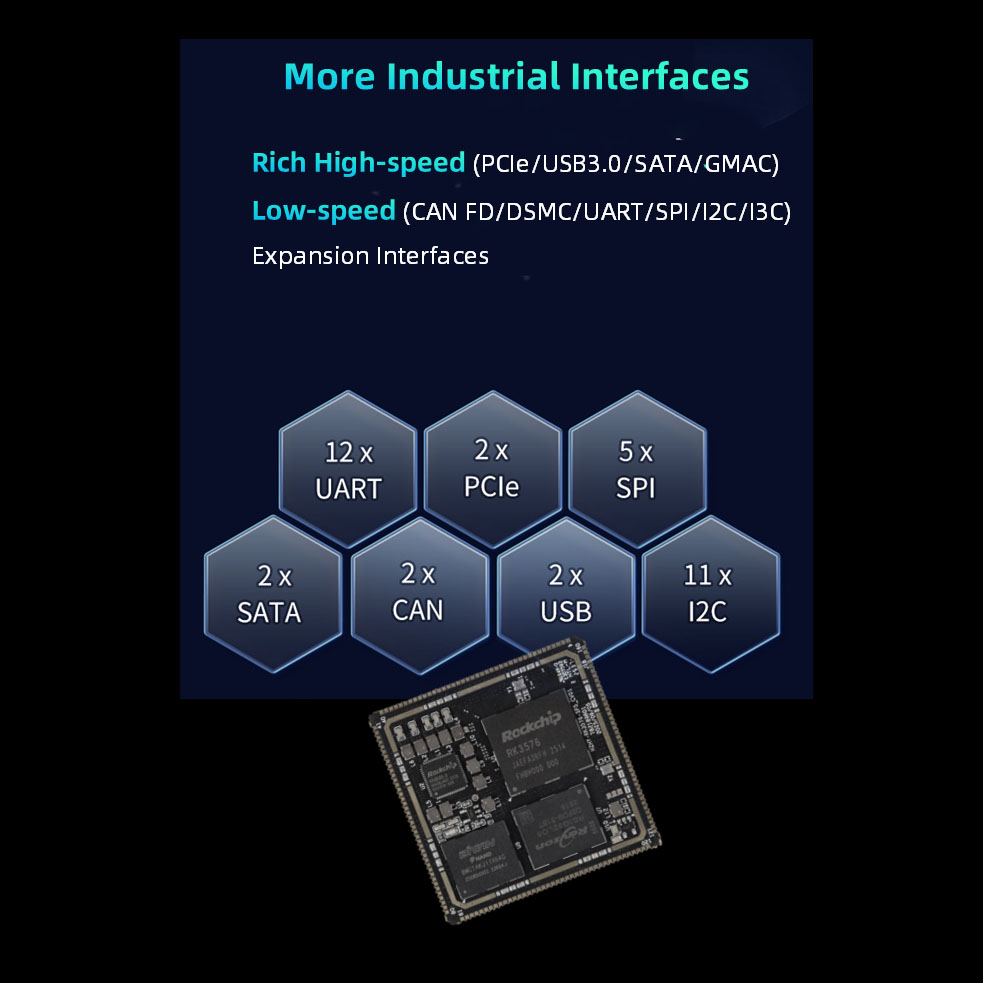
● SATA (≤2 channels): Supports SATA PM function, each port can support 5 devices; supports SATA 1.5Gb/s, SATA 3.0Gb/s, SATA 6.0Gb/s; supports eSATA.
Note: SATA0 and PCIe0 controllers are multiplexed; SATA1 and PCIe1 or USB3_OTG1 controllers are multiplexed;
● PCIe (≤2 channels): 2 PCIe 2.1 controllers, both only support RC mode;
Note: PCIe0 and SATA0 controllers are multiplexed; PCIe1 and SATA1 or USB3_OTG1 controllers are multiplexed;
● MIPI DPHY CSI RX (≤2 channels): 2 MIPI DPHY CSI RX ports, supporting 2/4-lane MIPI-CSI mode;
Note: Splitting into 2-lane + 2-lane mode is not currently supported; a maximum of 2 cameras can be connected;
● MIPI DCPHY CSI RX (≤1 channel): 1 MIPI DCPHY CSI RX port, supporting 1/2/4-lane MIPI-DPHY mode or 0/1/2 Trio MIPI-CPHY mode;
● Note: Splitting into 2-lane + 2-lane mode is not supported; the TX and RX of the MIPI DCPHY Combo PHY can only be configured simultaneously as DPHY TX and DPHY RX modes, or simultaneously as CPHY TX and CPHY RX modes. CIF (≤1 channel): 1 channel maximum 16-bit DVP interface, supports 8/10/12/16-bit;
Note: 3.3V interface, some pin resources are shared;
● HDMI TX (≤1 channel): Supports up to HDMI 2.1, maximum support for 4K@120Hz, supports HDMI FRL mode and is backward compatible with HDMI TMDS mode;
Note: Shared with eDP controller;
● eDP (≤1 channel): Supports up to eDP 3.1, maximum support for 4K@60Hz, supports 1/2/4 Lane modes, does not support Swap; Note: Shared with eDP controller;
● MIPI DCPHYCSI TX (≤1 channel): 1 MIPI DCPHYCSI RX port, supports 1/2/3/4 Lanes MIPI-DPHY mode or 0/1/2 Trio MIPI-CPHY mode;
● Note: Does not support splitting into 2Lane+2Lane mode; MIPI DCPHY Combo PHY's TX and RX can only be configured simultaneously as DPHY TX, DPHY RX mode, or simultaneously as CPHY TX, CPHY RX mode.
● DP (≤1 channel): Supports up to eDP 3.1, maximum support for 4K@120Hz, supports 1/2/4 Lane modes, supports Swap;
Note: Shared with USB3 OTG0's SS signal;
● LCD (≤1 channel): Supports 24-bit RGB mode, maximum resolution 1920x1080@60Hz; supports 16-bit BT1120 mode, maximum resolution 1920x1080@60Hz; supports 8-bit BT656 mode, maximum resolution 720x576@60Hz; Note: Some pin resources are shared.
● EBC (≤1 channel): Supports 8-bit/16-bit output, maximum 32 levels of grayscale, maximum resolution 2560x1920@85Hz;
Note: Some pin resources are shared.
● Audio (≤9 channels): 5 groups of SAI, supporting master-slave mode, 8 to 32-bit width, and sampling rates up to 48kHz; 2 groups of PDM, master mode, supporting 8-channel input capability, 16 to 32-bit width, and sampling rates up to 192kHz; 2 groups of SPDIFTX; 1 group of DSM PWMAudio;
Note: Four ASRC (Asynchronous Sample Rate Converter) modules are provided for audio data sample rate conversion;1.8V/3.3V interface, some pin resources are shared;
● Ethernet (≤2 channels): Supports 2 RGMII interfaces with 10/100/1000Mbps data transmission rates.
Note: 3.3V RGMII/RMII interface, some pin resources are shared.
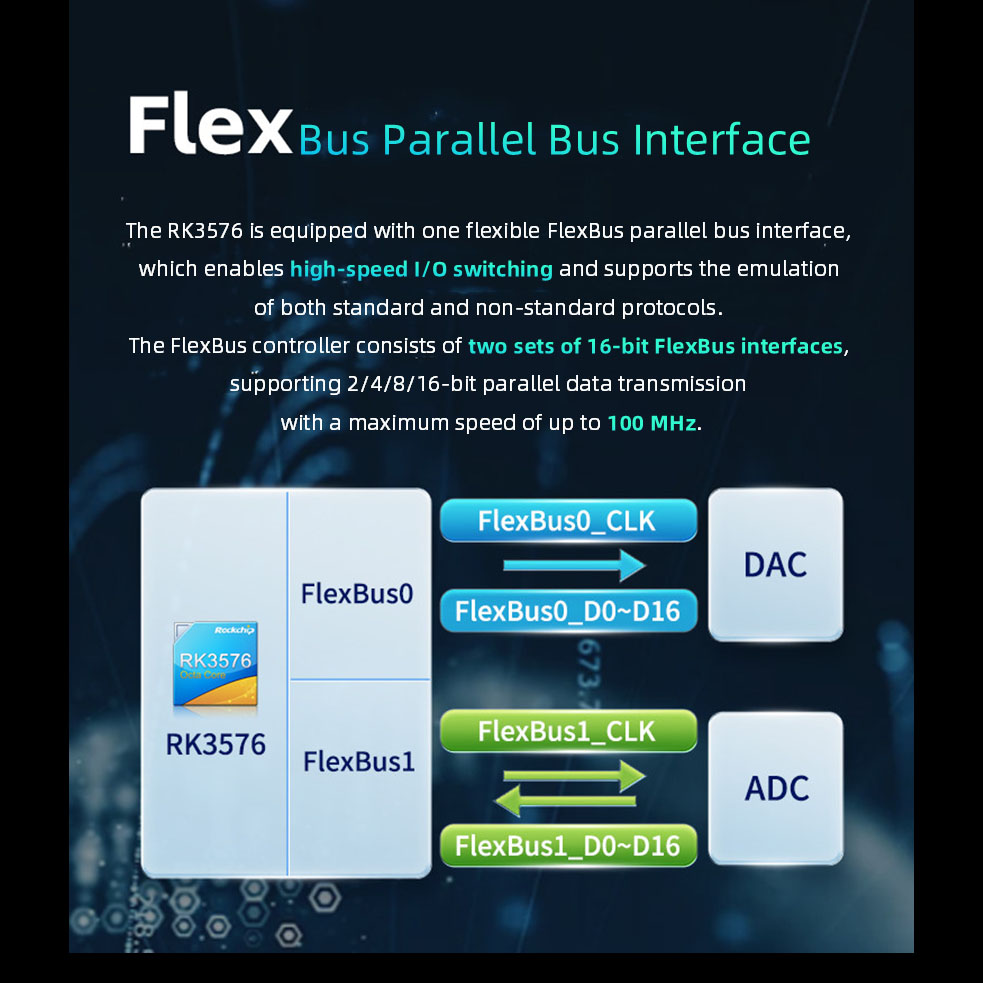
● FlexBus (≤1 channel): Supports one flexible parallel bus interface - FlexBus interface, which can achieve high-speed I/O switching, and can emulate some standard protocols or irregular protocols. A typical application scenario is the combination of a high-speed 16-bit ADC and a 16-bit DAC.
Note: 3.3V interface, some pin resources are shared.
● DSMC (≤1 channel): Double Data Rate Serial Interface. Mainly used in PSRAM device communication or peripheral communication of LocalBus (such as FPGA). Note: 3.3V interface, some pin resources are shared.
● UART (≤12 channels): Maximum supported baud rate is 8Mbps.
Note: 1.8V/3.3V interface, some pin resources are shared.
● I³C (≤2 channels): Supports 7-bit and 10-bit address modes, with a maximum speed of up to 12.5 Mbit/s, compatible with I²C bus, with a maximum speed of up to 400 Kbit/s. Note: 1.8V/3.3V interface, some pin resources are shared.
● I²C (≤11 channels): Supports 7-bit and 10-bit address modes, with a maximum speed of up to 400 Kbit/s.
Note: 1.8V/3.3V interface, some pin resources are shared. SPI (≤5 channels): Configurable master/slave mode. Note: 1.8V/3.3V interface, some pin resources are shared.
● CAN (≤2 channels): Supports CAN-FD; supports 1Mbps.
Note: 1.8V/3.3V interface, some pin resources are shared.
● PWM (≤3 channels): 3 independent PWM controllers, supporting up to 16 PWM channels, 32-bit timer/counter.
Note: 1.8V/3.3V interface, some pin resources are shared.
Note: Some pin resources are multiplexed. Please refer to the Pin Function Comparison Table for details.
Contact us for samples and more information!
Service Advantages
Minimum Order: 1 Unit | Bulk Orders Supported | Free SDK | Free Technical Support | Customization Accepted
RK3576 SOM Details


Hot Tags: Rockchip RK3576 SOM, Manufacturers, Suppliers, China, Buy, Wholesale, Factory, Made in China, Price, Quality, Newest, Cheap
Related Category
RV1126 Core Board
RK3568 Core Board
PX30 Core Board
RK3399 Core Board
RK3566 Core Board
RK3576 Core Board
Send Inquiry
Please feel free to give your inquiry in the form below. We will reply you in 24 hours.